

Introduction
Back in 2000, the TV show West Wing aired an episode where the main character, U.S. President Josiah Bartlet, ridicules a conservative radio talk show host who had called homosexuality an abomination. In response, President Bartlet makes the following speech:
“I wanted to ask you a couple of questions while I had you here. I’m interested in selling my youngest daughter into slavery as sanctioned in Exodus 21:7. She’s a Georgetown sophomore, speaks fluent Italian, always cleared the table when it was her turn. What would a good price for her be?
While thinking about that, can I ask another? My chief of staff, Leo McGarry, insists on working on the Sabbath. Exodus 35:2 clearly says he should be put to death. Am I morally obligated to kill him myself or is it OK to call the police?
Here’s one that’s really important, ‘cause we’ve got a lot of sports fans in this town. Touching the skin of a dead pig makes one unclean, Leviticus 11:7. If they promise to wear gloves, can the Washington Redskins still play football? Can Notre Dame? Can West Point?
Does the whole town really have to be together to stone my brother John for planting different crops side by side?
Can I burn my mother in a small family gathering for wearing garments made from two different threads?
Think about those questions, would you?”
Wiser Than Our Enemies
Now, pause for a minute and consider President Bartlet’s words. How would you respond to him? Is he correct in his understanding of the Old Testament? Is it silly for Christians to advocate any moral positions based on Old Testament laws?
These are questions that each of us, as Bible-believing Christians, have to be able to answer. Remember, like President Bartlet, the world will not hesitate to use God’s Word against us. We have to therefore be ready to answer these difficult questions without throwing the Bible under the bus.
In light of these criticisms, my purpose in writing this series of articles is to provide you with the tools necessary to respond confidently and effectively to those who challenge the morality of the Old Testament laws. More importantly, my goal is to actually challenge you, the reader, to study these laws and apply them to your life.
Does this mean that you might have to give up eating bacon? Not if you correctly understand and apply God’s law. Yet to do this accurately requires that we do a bit of work. Not only do we need to learn about the original context of the Old Testament laws, we also need to see how those laws apply now that Jesus Christ has come.
The first part of this series will address the foundational questions that we must answer before we start asking about eating bacon and wearing two different kinds of fabric. We need to know what God’s law is, why it matters, and what Jesus and the Apostles had to say about it. We need to know what purpose it continues to serve, if any, in the lives of 21st Century Christians. Only then, when that foundation is laid, will we be able to look at how to apply specific laws from the Old Testament.
The analysis of specific laws, such as the Ten Commandments, will be addressed at a future time. But even when I do look at them individually, my purpose will not be to exhaustively see how each law would apply in the modern world. Rather, I intend to organize each law categorically in order to present a broader understanding of the wisdom, beauty, and uniqueness of God’s law.
Ultimately, my goal is that you would come away from this series with a greater love and appreciation for God’s law, as well as a desire to apply it to your own life as a Christian. Jesus himself intends for his followers to “go and bear fruit” and that their “fruit should abide.”[1] Yet what does that fruit look like? What is the connection, if any, between obeying God’s law and bearing fruit? These are questions that I intend to help you answer over the course of the next several months.
Defining Terms
Before we begin, it is always important for us to define terms, especially on a topic as weighty as God’s law. At the most basic level, a law can be defined as an obligation placed by a superior (i.e., the law giver) upon a subordinate (i.e., the law receiver). Furthermore, it is binding in such a way that if the receiver violates the law, a debt is owed to the giver.
In the scientific realm, a law is not so much a moral obligation as it is something that explains an observed universal behavior. That is, scientific laws are focused more on the “is” rather than the “ought.” If a scientist says that the rock in his hand “ought” to fall when he lets go of it, he is neither implying that the rock has the ability to disobey the law of gravity nor that it would be morally culpable for doing so if it somehow failed to fall.
Yet, when we speak about laws regarding human behavior, we are speaking more about the “ought” than the “is.” A person “ought” to behave a certain way, not because he naturally tends to do so but because he would be held accountable for not doing so. To violate the law would result in some sort of debt to the law-giver. This would be followed by a set of negative experiences. Some of those effects might simply be the natural results of a particular action, while others might be specifically given as punishment for the debt incurred. Either way, these types of laws imply a certain standard of behavior. That standard is determined by the law-giver. And so, all laws have law-givers. In the case of God’s law, God is the law-giver. He imposes obligations of behavior upon mankind that, when broken, incur a debt that must be paid.
At this point we need to pause and consider what we mean when we refer to “God’s law.” Which laws? And for whom? Well, in a very broad sense, God’s law refers to the standard of behavior that He holds all of humanity accountable to. It is the standard of perfect holiness and righteousness that reflects God’s nature and character.
The Question of Covenant
One thing to keep in mind is that God’s law, like God himself, has unchanging aspects to it. These are often referred to as universal moral principles or the moral law (more on that later). But, the specific application of these principles upon mankind have experienced changes throughout the ages. These changes were not due to a change in God’s character but were based upon mankind’s covenantal relationship to God. This word, covenant, is key in our discussion of God’s law, as it will help us to avoid falling into a variety of errors. Simply put, God has interacted with mankind through different covenants, each of which has slight differences in terms and obligations. How we understand the relationship between the covenants, and the inauguration of the New Covenant, is going to drive how we understand God’s law.
While I do not intend to enter into a lengthy analysis of Covenant Theology, New Covenant Theology, or Dispensational Theology, I want to provide you with some basic principles for understanding the various covenants in Scripture.
To begin, a covenant is, quite simply, an oath-bound commitment or promise involving two or more parties.[2] A common modern example of a covenant is the bond of marriage. A man and a woman, having an already established relationship, enter into a more formal oath-bound commitment that involves the making of promises and the giving of a sign, or seal. Both the husband and the wife have obligations to one another, but their commitment is not based on the performance of the other person. It is a promise.
Although much more could be said on covenants, this is the basic structure of how God interacts with His people throughout Scripture. The first covenant, between God and Adam, involved certain blessings for obedience and curses for disobedience. For Adam, obedience involved being fruitful and multiplying, exercising dominion over the earth, keeping and tending the garden, and not eating the forbidden fruit.[3] When the covenant was broken, a debt was incurred and death entered the world.
The second covenant, between God and Noah, was a slightly altered version of the first covenant. The obligations regarding being fruitful and exercising dominion remained the same, yet Noah and his descendants were now allowed to eat meat, so long as there was no blood in it. God signed and sealed this covenant in providing the rainbow.[4]
The third covenant, between God and Abraham, involved God promising Abraham a people and a land. A new obligation on Abraham’s part was to be circumcised and to have all the males in his household circumcised. This obligation served also as a sign of the covenant for all of Abraham’s descendants, much like the rainbow was a sign for all of Noah’s descendants.[5]
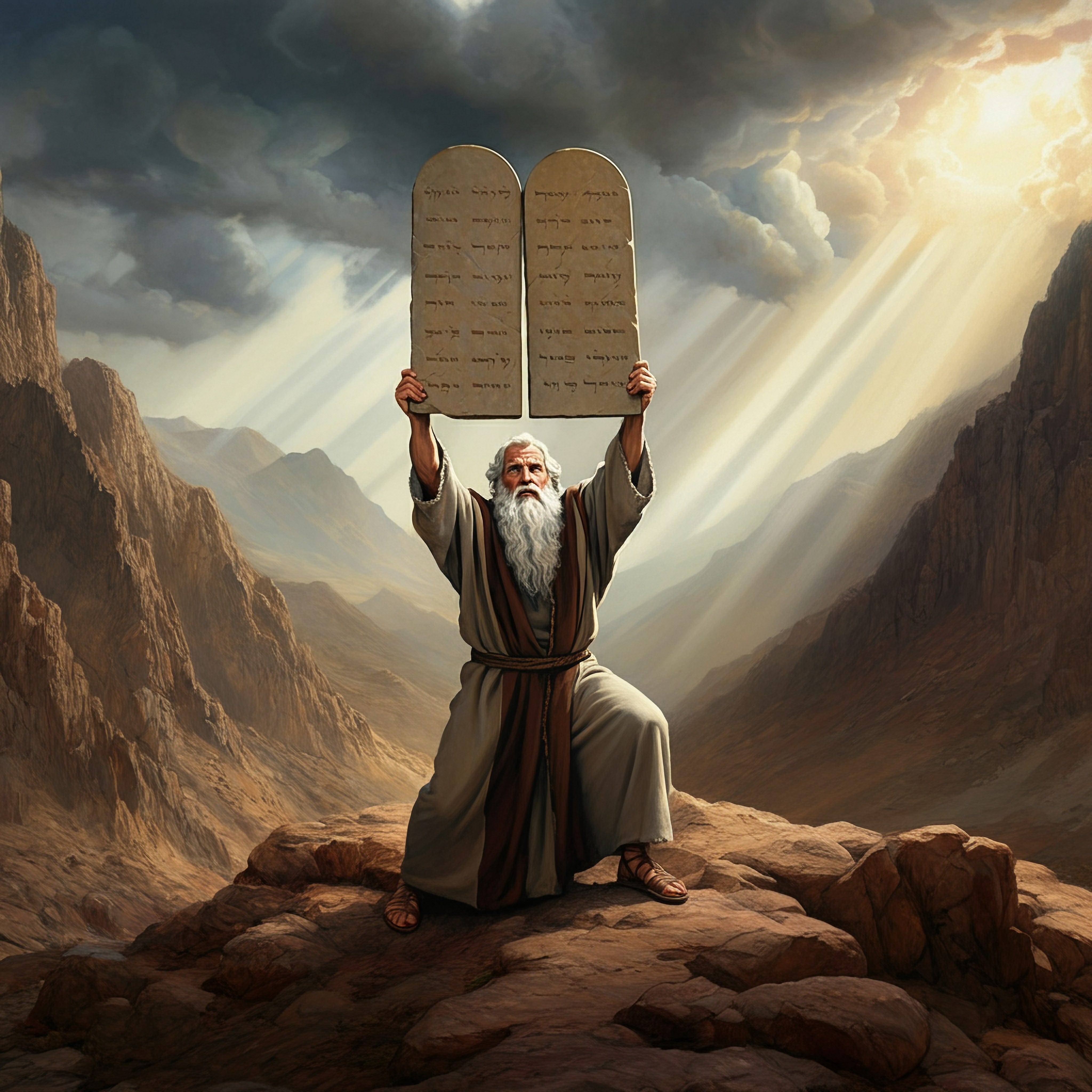
The fourth major covenant, between God and the people of Israel, with Moses as their representative, involved the giving of a set of obligations (i.e., the Mosaic Law) when God redeemed Israel out of slavery in Egypt. These obligations, summarily expressed in the Ten Commandments, were written on tablets of stone and placed in the Ark of the Covenant to serve as the covenant documents between God and His people.[6]
It is these obligations given in the Mosaic Law that we tend to refer to when we talk about God’s law today. Of course, there is nothing wrong in doing this, for a strong case could be made that when the New Testament speaks of “the law” it is generally referring to the obligations set forth in the Mosaic Covenant. In any case, the use of the phrase “the law” in Scripture must always be determined by the context of the passage in which it appears.
Similarly, when referring to God’s law, we must take care to be accurate and consistent in what we are saying. God’s standard of righteousness is not only presented in the Mosaic Covenant but in other covenants as well. Both the New Testament and the Old Testament contain specific commands for God’s people. So how are we to put them all together? How are we to understand the covenants, including their obligations, in relation to one another?
The key to this is recognizing the covenant that we are currently under. Today, that is the New Covenant, inaugurated by the life, death, burial, resurrection, and ascension of Jesus Christ. Not only does it contain both promises and obligations for those who are partakers of it, but it also is confirmed by signs and seals.[7]
Conclusion
Ultimately, if we are going to properly understand and apply God’s law as it is commonly defined (i.e. the Mosaic law), we need to view it in light of Christ and the New Covenant. God’s law, at its core, simply refers to what people are obligated to believe, say, and do at any given time. Under the Old Covenant, that would have clearly been the Ten Commandments and all its associated laws. But since we are living under the New Covenant era, we can rightly define “God’s law” as what people are obligated to believe, say, and do in a world where Christ is Lord of lords and King of kings. This does not mean that we can discard the Mosaic Law as an artifact of history. Rather, it means that we need to look at the Mosaic Law from the perspective of those standing on this side of the cross.
Yet before we go any further, we need to take some time to consider two misconceptions that appear to be common among evangelicals today: that the presence of the Holy Spirit within believers makes studying the Old Testament law unnecessary and that Christ’s fulfillment of the Old Testament law makes it irrelevant. I will be addressing each of these misconceptions over the next several articles.
[1] John 15:16
[2] Gentry and Wellum, Kingdom Through Covenant, 132.
[3] Genesis 1:26-30; 2:15-17.
[4] Genesis 9:1-17.
[5] Genesis 17:1-14.
[6] Deuteronomy 4:1-14.
[7] Jesus explicitly mentions the Lord’s Supper as a sign, or ordinance, of the New Covenant in Matthew 26:28.