

The Lord God took the man and put him in the garden of Eden to work it and keep it. And the Lord God commanded the man, saying, “You may surely eat of every tree of the garden, but of the tree of the knowledge of good and evil you shall not eat, for in the day that you eat of it you shall surely die.” (Genesis 2:15-17)
Introduction
Before we look at specific statutes and ordinances of the Mosaic Law, it is essential that we first consider the form and function of God’s law prior to the time of Moses. As Christians, we affirm the doctrine of progressive revelation—that God reveals his will, his redemptive plan, and even his law incrementally across history. While God’s moral nature never changes, the specific requirements that he places upon his people undergo purposeful adjustments with each change in covenant administration.
When we look at redemptive history, we find that people are held accountable to the revelation that they possess and to the covenant that they are under. Jesus makes this point in the Parable of the Master in Luke 12:41-48. In that parable, a master leaves his house in the care of several servants. One of those servants, who knew the master’s will, chooses instead to misbehave and mistreat the other servants. Upon the master’s return, that servant is beaten severely while the other servants, who did not know the master’s will but still misbehaved, are beaten lightly. Jesus ends the parable by saying, “Everyone to whom much was given, of him much will be required, and from him to whom they entrusted much, they will demand the more.”
The basic idea behind this parable is the level of accountability that God holds people to. That is, the more knowledge and understanding that someone has of God’s will, including his law, the greater the consequences for disobedience. This connects both with progressive revelation and with the progression of covenants. Both are referred to in Hebrews 7:11-12 when it says that a change in the priesthood (i.e., covenant) results in a change in the law (i.e., revelation).
With this in mind, we can deal with the fact that certain prohibitions and requirements do not seem to appear until the time of Moses, while other prohibitions and requirements seem to change multiple times throughout redemptive history. Yet these changes do not mean that God is arbitrary or that there is no universal moral standard. Rather, by tracing the development of God’s law from Adam to Abraham, we can see that God’s law has always existed and that the change in the elements or form of certain laws is always tied to the change in the covenant/priesthood.
The Adamic Covenant
The story of God’s law begins at the dawn of creation in the Adamic Covenant, where God establishes both a positive law (what man must do) and a negative law (what man must not do) prior to the entrance of sin. The first positive command—often called the Creation or Dominion Mandate—is recorded in Genesis 1:28–30:
And God blessed them. And God said to them, “Be fruitful and multiply and fill the earth and subdue it, and have dominion over the fish of the sea and over the birds of the heavens and over every living thing that moves on the earth.” And God said, “Behold, I have given you every plant yielding seed that is on the face of all the earth, and every tree with seed in its fruit. You shall have them for food.”
Here, Adam and Eve were commissioned by God as stewards and vice-regents (or, more accurately, vice-gerents) over the earth. They were commanded to multiply the image of God across the globe and exercise righteous dominion by cultivating the wilderness and expanding the borders of the Garden of Eden until the entire earth reflected God’s order. At this point in history, there was no death and no bloodshed, and so both humans and animals were given a strictly plant-based diet.
Alongside this positive commission to fill the world and subdue it, God instituted a specific negative law in Genesis 2:15–17:
The Lord God took the man and put him in the Garden of Eden to work it and keep it. And the Lord God commanded the man, saying, “You may surely eat of every tree of the garden, but of the tree of the knowledge of good and evil you shall not eat, for in the day that you eat of it you shall surely die.”
Interestingly, this passage describes Adam’s role using priestly language, since to “work it and keep it” (tend and guard) is the same terminology later applied to the Levitical priests guarding the sanctuary of the Lord. And so, Adam was tasked with maintaining order against chaos and protecting the garden sanctuary from both external and internal threats.
The prohibition against eating from the Tree of the Knowledge of Good and Evil is probably best seen as a requirement for humble dependence. Nothing in the text indicates that the tree itself was inherently evil. Rather, the sin seems to be in seizing the knowledge to “be like God” autonomously and prematurely rather than waiting upon God’s timing. While I acknowledge that this argument is ultimately speculative, it seems to line up with other parts of Scripture, such as when Christians are called to image Christ and be perfect as our Heavenly Father is perfect. To give an example, two runners may appear to run the exact same race in the exact same manner, yet one runs in humble reliance upon God’s strength while the other runs in prideful attempt at self-glorification. Similarly, we are called to be like God in the sense of being conformed to the image of Christ, but this is a work that God does, not something that we do for ourselves.
Regardless of whether or not the Tree of Knowledge was inherently evil, it is worth noting that both the positive and negative laws given in Genesis were given before the Fall. That is, Adam and Eve received them with uncorrupted faculties of reason, emotion, and intellect. This seems to indicate that they were not naive or ignorant children but were rather wise and intelligent moral agents operating at peak human capacity, fully capable of comprehending the warning about death.
Of course, when Adam and Eve broke the covenant in Genesis 3, God pronounced curses upon all parties involved. Yet he did not change or revoke the law. Humanity was still required to be fruitful, multiply, and take dominion, although doing this would be far more difficult and painful.
There is one final point I would like to make concerning God’s law under the Adamic Covenant. We can see in the incident between Cain and Abel that the unwritten moral law against murder was present. For when Cain murdered his brother Abel, no explicit prohibition against homicide had been given. Nevertheless, Cain seemed to have recognized his guilt (even if he remained unrepentant), and God held him fully accountable. How is this possible? Well, as someone made in the image of God, Cain knew intuitively that destroying another image-bearer was wicked and completely antithetical to the Creation Mandate. This is affirmed by the Apostle Paul in Romans 2:14–15 when he argues that even without a written code, the work of God’s law is written on the human heart. Despite being marred, scarred, and twisted by the Fall, the image of God remains within mankind, leaving all of us without excuse for our behavior.
The Noahic Covenant
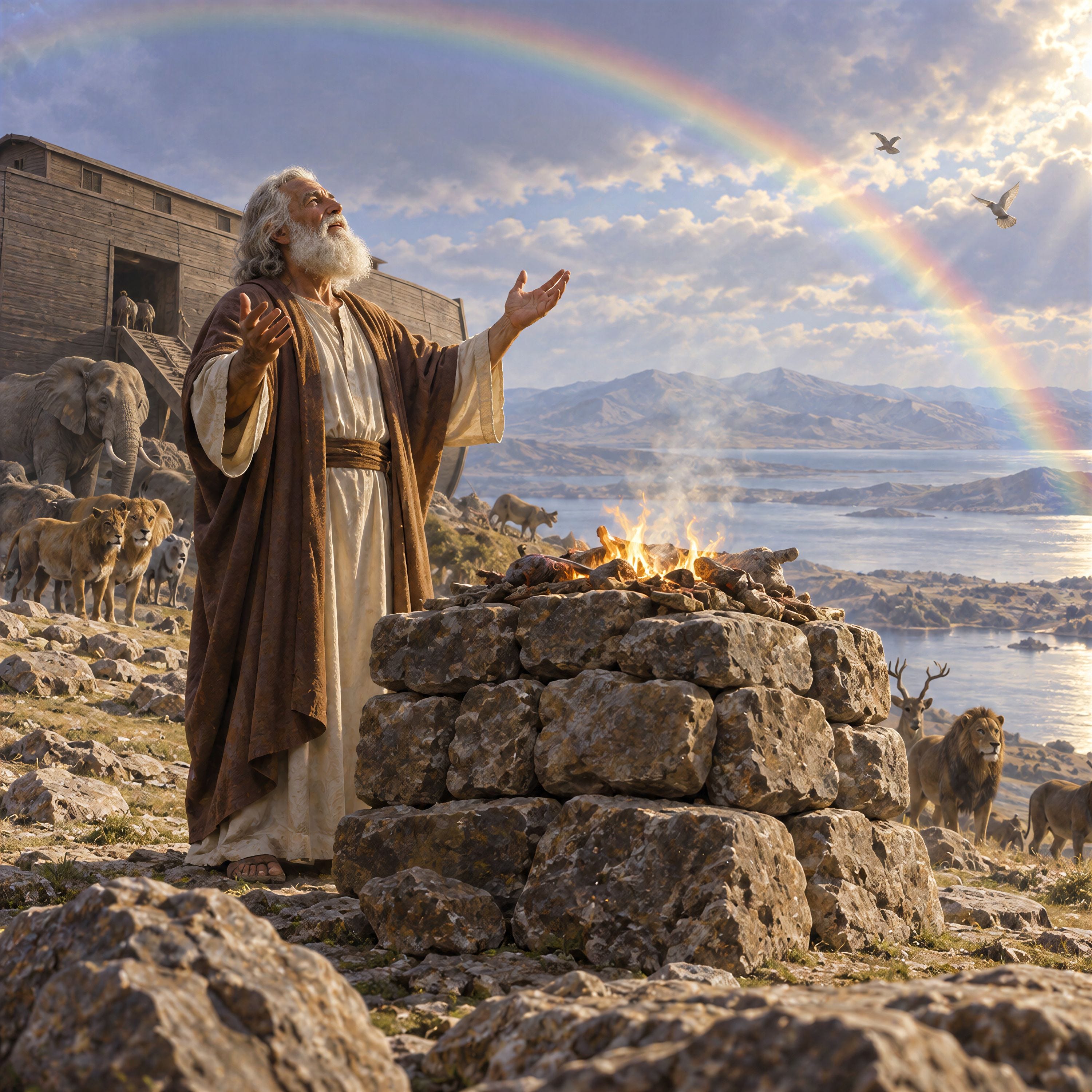
Following the judgment of the Great Flood, God established another covenantal administration with Noah in Genesis 9:1–7, reaffirming the Creation Mandate while introducing several changes:
And God blessed Noah and his sons and said to them, “Be fruitful and multiply and fill the earth. The fear of you and the dread of you shall be upon every beast of the earth and upon every bird of the heavens, upon everything that creeps on the ground and all the fish of the see. Into your hand they are delivered. Every moving thing that lives shall be food for you. And as I gave you the green plants, I give you everything. But you shall not eat flesh with its life, that is, its blood. And for your lifeblood I will require a reckoning: from every beast I will require it and from man. From his fellow man I will require a reckoning for the life of man. ‘Whoever sheds the blood of man, by man shall his blood be shed, for God made man in his own image.’ And you, be fruitful and multiply, increase greatly on the earth and multiply in it.”
In this Noahic Covenant, we see three significant developments. First, there is the institution of capital punishment. This was not something that had existed (at least by God’s command) prior to the flood. Consider the fact that when Cain murdered Abel, God placed a protective mark upon Cain forbidding anyone from executing him out of revenge. Yet despite this great mercy from God, the line of Cain continued in its rebellion, resulting in increased depravity and corruption throughout the earth.
After the flood, capital punishment would serve as a restraint against evil. An additional restraint would be seen in the reduction of the human lifespan (Genesis 6:3). Just consider that, before the flood, the human lifespan could reach eight or nine hundred years. Now, imagine sinful, depraved people living for such a long time. How efficient and effective do you think they would be at sinning after centuries of practice? We struggle with comprehending the horrors of modern tyrants like Hitler, Stalin, or Mao, whose reigns lasted only decades. Yet imagine the depravity that men like them could achieve over centuries without the restraint of either the civil sword or a reduced lifespan.
The second significant change from the Adamic Covenant to the Noahic Covenant involved the human diet. Whereas Adam was restricted to eating only the green plants, God expanded the menu under Noah to include all animal flesh without any distinction between clean and unclean animals (although the concept of clean and unclean animals already existed at the time of Noah). The only prohibition was the consumption of blood (it being the source of life), which would later be reinforced and expounded upon under the Mosaic Covenant.
The third change occurred in the relationship between man and animals. Just like men who destroy the image of God are now to be put to death under the Noahic Covenant, any animal that takes a human life also forfeits its own. This is to be done even though the animal is not a moral agent in the way that a person is. And yet, God takes it very seriously when an image-bearer is destroyed. Interestingly, the practice of putting down animals who kill humans is still enforced today by civil governments around the world, whether it is predatory animals or domestic animals.
Related to the above requirement, God also placed the fear and dread of man upon the animals. It is important to note that this is a change from how things were before the flood. And so when skeptics often scoff at how Noah could have gathered wild animals into the Ark, they forget that, prior to this, animals lived in submission and close proximity to humanity without natural terror. It is hard for us today to imagine what this would have been like, although there are many who seem to yearn for that. We see this pursuit of a kind of Edenic harmony when people desire to pet wild bison or keep exotic predators as pets, which usually does not end well. This is a desire that will only be fulfilled in the New Heavens and New Earth, where the lion will lie down with the lamb and the child will play safely by the cobra’s den (Isaiah 11:6–8).
Remarkably, modern secular science confirms the reality of the fear of man among the animals. Ecological research published in American Scientist tracked the behavior of apex predators such as pumas, cougars, and bears, revealing that these animals view physically smaller, clawless humans as “super predators.” And so the predators will naturally go out of their way to flee the mere sound of human voices, drastically altering their feeding and hunting schedules to avoid human contact. Given the relative physical weakness of humans compared to these animals, there is no good reason – besides the Noahic Covenant – for why such predators would behave in this way.
The Abrahamic Covenant
The third pre-Mosaic administration is the Abrahamic Covenant, recorded in Genesis 17:9–14. In it, God calls Abraham to trust in him and promises to bless him with both a land and a people. As a sign of his covenant promises, not only does God promise the birth of a son but also inaugurates the practice of circumcision:
And God said to Abraham, “As for you, you shall keep my covenant, you and your offspring after you throughout their generations. This is my covenant, which you shall keep, between me and you and your offspring after you: Every male among you shall be circumcised. You shall be circumcised in the flesh of your foreskins, and it shall be a sign of the covenant between me and you. He who is eight days old among you shall be circumcised. Every male throughout your generations, whether born in your house or bought with your money from any foreigner who is not of your offspring, both he who is born in your house and he who is bought with your money, shall surely be circumcised. So shall my covenant be in your flesh an everlasting covenant. Any uncircumcised male who is not circumcised in the flesh of his foreskin shall be cut off from his people; he has broken my covenant.”
The use of circumcision as the covenant sign is not arbitrary but carries multiple levels of significance. First, it was applied specifically to males because they served as the covenantal heads of both their households and the nation. Second, given the reality of male anatomy, circumcision was such that it served as an inescapable, deeply personal daily reminder that the man—and his entire household whom he represented—belonged exclusively to the Lord. Third, by placing the covenantal mark directly upon the reproductive organ, God linked his promise of making Abraham the father of many nations directly back to the Creation Mandate for mankind to “be fruitful and multiply” throughout the earth.
It is worth mentioning that the requirement that circumcision be conducted on the eighth day was also not arbitrary. Not only does it signify redemption (seven days of Creation and then the eighth day as New Creation), but it also aligns with human biology/design. That is, modern medical science has discovered that newborn infants are born with low levels of Vitamin K (which does not easily cross the placental barrier and is essential for blood clotting). Throughout the first week of life, a newborn’s level of Vitamin K will steadily rise, peaking right around the eighth day. And so, long before ancient civilizations understood hematology or Vitamin K deficiency bleeding, the Creator of the human body prescribed the exact day optimal for the surgical procedure of circumcision.
The final point I want to make regarding circumcision under the Abrahamic Covenant is that it was to be given to all males without distinction. While surrounding pagan cultures like Egypt already practiced circumcision, they restricted it to elite nobles and priests and performed it on adolescent boys as an earned rite of passage into manhood. In stark contrast, God commanded that every male in Abraham’s household—from the master to the foreign-born servant—receive the sign, foreshadowing that all of God’s people would be a “kingdom of priests” (Exodus 19:5-6). Furthermore, by commanding it on the eighth day of infancy, when the child had no ability to choose or earn the status, God demonstrated that covenant inclusion and salvation are purely works of divine grace, not human achievement.
Conclusion
As we reflect on the various changes from one covenant to another, we should be able to see how the change in priesthood/covenant – as explained in Hebrews 7 – results in changes to the law. When redemptive history moves from the Abrahamic Covenant to the Mosaic Covenant, numerous additional changes occur. The same can be said with Christ’s first coming. Under the Mosaic Covenant, the priesthood was tied to the tribe of Levi. Yet Jesus Christ, who is from the tribe of Judah, is now our great High Priest after the order of Melchizedek. And so, this change in the priesthood brings with it certain changes to various elements of God’s law, all of which are explicitly shown in the New Testament.
One of the clearest examples of this is that of dietary laws. Under Adam, humanity ate only plants, while under Noah and Abraham all meat was permitted except that which still contained blood. Later, under Moses, meat was restricted to clean animals only. Now, under the New Covenant inaugurated by Christ, the dietary divisions are explicitly abrogated, returning believers to freedom. Yet even this freedom is not to be exercised if it causes a brother to stumble (Romans 14:20-21). And so there remains a dietary restriction in the sense that what we eat and drink is restrained by both our consciences before God and by our love for fellow believers. It is important to remember, though, that the requirement to remain clean and pure before a holy God has not changed. The only change is in how this is acquired and maintained. The blood of Christ is what cleanses and purifies us, not the circumcision of the flesh, the observance of a special diet, or the sacrificial offering of animals.
While the New Testament demonstrates an explicit change in things such as dietary laws and animal sacrifices – how we are able to be clean and pure before a holy God – it does not loosen what it means to love our neighbor. Behavior such as murder and sexual immorality remain evil and a violation of God’s law. And while capital punishment was initially withheld under the Adamic Covenant, it remains a requirement under the New Covenant. This is because there is nothing in the text of the New Testament to indicate that the requirement for capital punishment, inaugurated since the time of Noah, has been abolished. Jesus himself will return in final judgment, executing the wicked in a very public manner. And the Apostle Paul expressed that he had no problem being executed if he had committed a crime deserving death (Acts 25:11).
Based on this covenantal/priesthood framework, we should be able to easily answer the secularists when they ask why Christians can now eat pork or shellfish while still refusing to approve of adultery and homosexuality. In fact, rather than loosening sexual ethics, Jesus elevates and tightens marital restrictions under the New Covenant. Under Abraham and Moses polygamy was allowable, even if not ideal. Yet Christ restores marriage to its original Edenic standard: one man and one woman for life. Furthermore, the New Testament forbids believers from being unequally yoked with unbelievers, to include marriage (2 Corinthians 6:14).
The bottom line is that when the New Testament is silent on an Old Testament law—such as with the condemnation of bestiality—this should not be assumed to mean that the law no longer applies. God does not need to repeat every law in every covenant for it to remain binding. And so as we approach the study of specific Mosaic Laws throughout the rest of this book, we need to do so as members of the New Covenant, recognizing Jesus as the new and final High Priest who has fulfilled the law, not abolished it.